
THE STORY
Has AI drawn the line for you?
Answered.
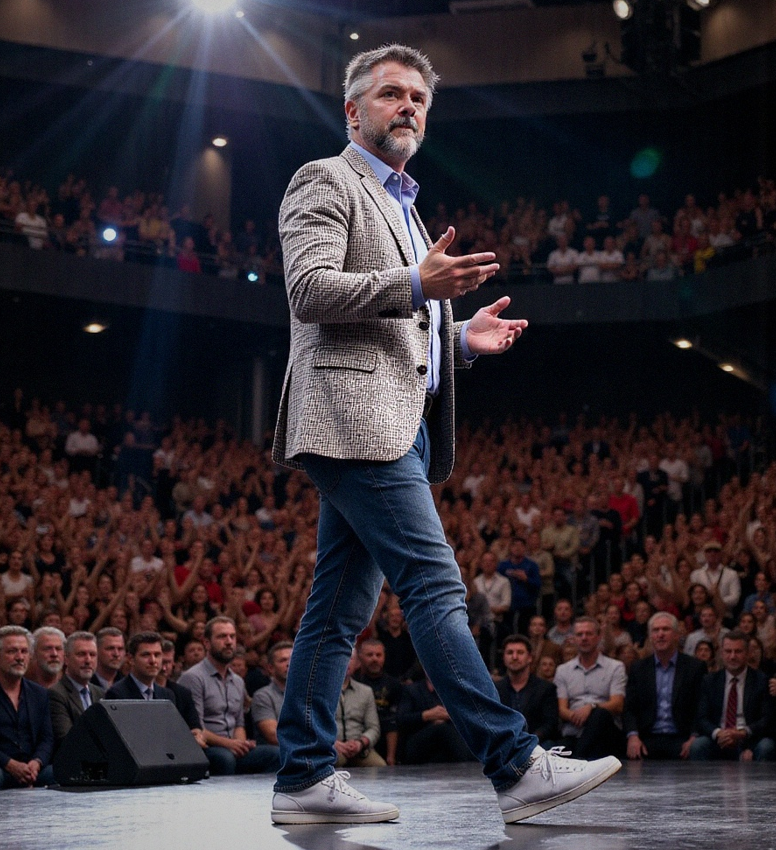
PART ONE - WHAT I SAW
I spent decades watching media move people.
Radio. Television. Print. Marketing. Army PR. I owned stations, ran sales for Telemundo, built a marketing and advertising firm that worked for decades
because we understood one thing everyone else was walking past: communication has consequences, and the difference between a message that changes behavior and one that gets ignored isn't the information. It's the delivery to a brain that's ready to receive it.
I watched thirty-second spots produce stampedes. I watched a well-constructed headline change a market. I watched a radio campaign do in a week what a sales team couldn't do in a quarter.
Then I'd walk into a corporate training room and watch nothing happen.
Same information. Different result. And nobody seemed bothered by it. I was.
PART TWO - THE 40 MPH MOMENT
Twelve years ago a distracted driver hit my daughter and me at 40 mph while we were on my Harley Road Glide.
She recovered. Completed college on a partial scholarship to Texas A&M for barrel racing and graduating in English. I'm proud of her every single day.
I had my right leg amputated below the knee. Hip shattered. Right arm avulsed and reattached. Dozens of other breaks and fractures I've stopped counting.
When you're in recovery with that much time and that much pain, you think. You read. You reach. My network delivered a cognitive neuroscientist whose life's work was studying exactly how the brain processes information and how people love to learn.
I already knew NLP. The power of language well constructed. Waitley's The Psychology of Winning. Zig Ziglar. Napoleon Hill. Covey. I'd been living inside the classics of influence and persuasion my entire career.
What the neuroscientist gave me was the why underneath all of it. Off I went.
PART THREE - THE NIKE PROOF
The first Nike pilot produced spectacular results. We expected that.
The second pilot had a different market, different culture, completely different people. Exact same numbers.
That's when I knew. Not that the methodology worked. I already believed that. What I knew in that moment was something bigger: the brain doesn't negotiate with culture. It processes information the same way in every room, in every country, in every organization. Which meant the results weren't about Nike. They were about working with the mind rather than forcing it into submission.
That's what every training program I'd ever seen was doing. Forcing. Filling. Checking boxes. Treating the brain like a container instead of an architecture.
And that's what media had always understood that L&D never did.
PART FOUR - WHAT THIS IS
The accident didn't change what I knew. It gave me the science to explain it. And a neuroscientist named Dr. Kieran O'Mahony to build it properly.
Brain-centric Design is what happens when decades of watching media move markets meets the neuroscience of how learning actually works.
THE COGNITIVE DIVIDE
There is a line
Above it, humans think in ways AI cannot replicate: analytically, evaluatively, creatively.
Below it
we outsource that thinking and slowly lose the capacity to do it ourselves.
I didn't invent that line. I was the first to name it.
The Cognitive Divide.
I built the methodology to help people cross it. That's what this is.


